DMCA PROTECTED AND MONITORED

© COPYRIGHT – ALL RIGHTS RESERVED. This site is protected and monitored by DMCA.COM - ANY UNAUTHORIZED Reproduction, Duplication, Distribution of any kind is STRICTLY PROHIBITED. All original content is created by the website owner, Barron Shepherd, including but not limited to text, design, code, images, photographs and videos are considered to be the Intellectual Property of the website owner, Barron Shepherd, whether copyrighted or not, and are protected by DMCA Protection Services using the Digital Millennium Copyright Act Title 17 Chapter 512 (c)(3). Direct linking, reproduction or re-publication of this content is prohibited without permission. Under 17 U.S.C section 101 et seq. those who violate the DMCA could be liable for statutory damages as high as 150,000.00 as set forth in section 504(c)(2) therein.

Monday, August 3, 2026

Restricted Judo: The Ghost Manual That Refused to Stay Buried


For decades, it existed more as rumor than history.

A thin wartime manual stamped "RESTRICTED." Internet claim fueled on speculation instead of evidence. Over time, the Restricted Judo syllabus became something of a ghost manual, a document everyone seemed to know about, but very few truly understood. Names were attached to it. Legends were repeated. Assumptions became accepted as fact. Eventually, WWII Hand to Hand Combat folklore overshadowed the historical record itself. 

But what if the real story was even more fascinating?

That question began a research journey that led through military archives, period newspapers, Army records, wartime photographs, and forgotten documents from the U.S. Army Amphibious Training Center at Camp Gordon Johnston, Florida. Piece by piece, a different picture began to emerge, not one built upon hearsay, but upon surviving evidence.

Restricted Judo: The History and Development of the U.S. Army Amphibious Commando Train-the-Trainer Program

This is not a reproduction of an old military manual. Nor is it another collection of wartime fighting techniques.

Instead, it is a historical investigation into how one of the U.S. Army's most intriguing hand-to-hand combat programs was developed, organized, and taught during World War II.

One of the discoveries that surprised me most was that the Restricted Judo syllabus reveals far more than a list of techniques. It presents a carefully structured educational system. Every section builds upon the previous one. Soldiers first learned the psychology of combat, then stance, balance, striking, elbows, rear attacks and sentry removal. Rather than a random assortment of rough and tumble dirty fighting techniques, the course reads like a progressive instructor-training curriculum designed to produce competent combatives instructors capable of teaching others.

The book also explores the instructional philosophy behind the syllabus. Why were certain techniques chosen while others were omitted? Why did Captain Oscar L. Joyner Jr. and Sergeant Edward Anglin emphasize gross-motor movements over more elaborate techniques? How did the demands of amphibious warfare influence the design of the program? These questions reveal a curriculum engineered around battlefield realities rather than sporting competition.

Perhaps most importantly, Restricted Judo separates historical documentation from modern interpretation.

Throughout the book, every effort has been made to distinguish between the original 1943 syllabus, evidence drawn from military records, historical analysis (the first two sections of the book), and my own modern instructional developments (final section).

Where the historical record ends, I say so. Where modern applications begin, they are clearly identified. I believe preserving that distinction is essential to honoring both the history of the program and the readers who want an accurate account of its development.

The final section of the book, Expanding Restricted Judo, explores how the principles taught by Joyner and Anglin can be logically extended into modern combative training. These are not presented as "lost" wartime techniques or rediscovered material. They are my own developments, built upon the same principles of balance, leverage, body-mass transfer, offensive initiative, and tactical simplicity that define the original syllabus.

In many ways, this project has become more than the story of a manual.

It is the story of how history can become obscured through repetition, how myths can overshadow evidence, and how careful research can bring forgotten stories back into the light.

The Restricted Judo syllabus spent decades as a literal ghost manual. It evolved into an urban legend. My hope is that this book helps return it to what it should always have been, a documented and properly understood chapter in the history of U.S. Army Hand to Hand Combat.

History deserves more than repetition. It deserves investigation.

Restricted Judo: The History and Development of the U.S. Army Amphibious Commando Train-the-Trainer Program is coming soon. 

Tuesday, February 25, 2025

Osoto Gari vs Multiple Punches – Cover and Crash Entry

Barron Shepherd’s Combat Judo differs from traditional Judo in several key ways, largely in its focus and application. While both are rooted in the same Japanese martial arts principles, Combat Judo is specifically tailored for real-world combat situations. 

Here are some key differences that set it apart from traditional Judo. 

Shepherd’s Combat Judo is an evolution of traditional Judo, it emphasizes adaptability, incorporating tactics and strategies with Aggressive Timing and Speed. 

Shepherd’s system trains practitioners to react quickly with an explosive and ballistic direct or counter attack. The “ballistic” aspect also applies to the timing and speed of responses. A key part of ballistic movement is not just about strength, but also how fast and decisively an action is performed. The faster and more aggressive a response, the less chance the opponent has to react or defend themselves. 


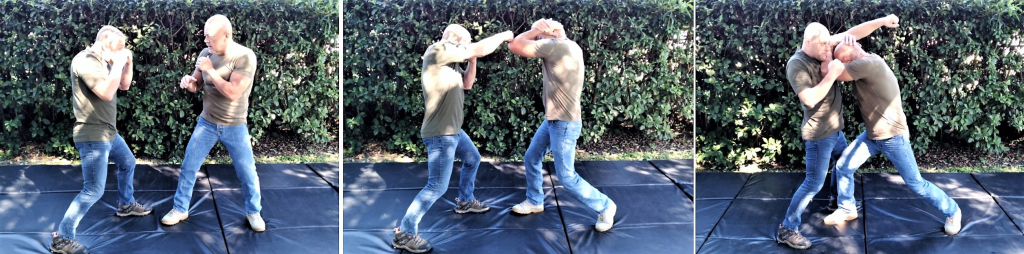
 Osoto Gari vs Multiple Punches – Cover and Crash Entry 

 “Covers” or “frames”  are  techniques or defensive postures created by using hand and arm positioning to block attacks and create a protective barrier around your head or body, particularly in close-quarters combat. These techniques are also used as entries to set up or fit into throws and takedowns.
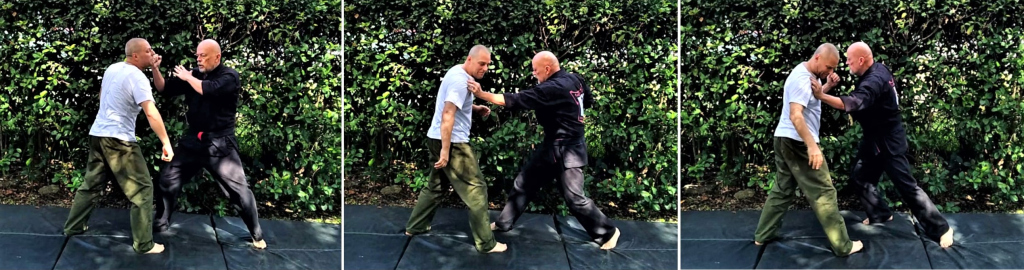
1.) Attacker is standing in a left foot forward fighting posture like a boxer. The defender is standing with his right foot forward and bladed off in ready fighting posture. The defender’s hands are up and his chin is tucked just below his right shoulder. 

2.) The Attacker throws a right straight punch or haymaker. The defender brings his left up and cups the back of his head. His right simultaneously comes up grabbing over the top of his left wrist to form a cover that deflects or blocks the incoming punch. 

3.) The Attacker throws a left punch. The defender switches the cover to the right side as he pushes off the left foot and steps his right foot forward. The defender crashes into the attacker with the cover stopping the attacker’s forward momentum and disrupting his posture, rocking him backwards on his heels.  
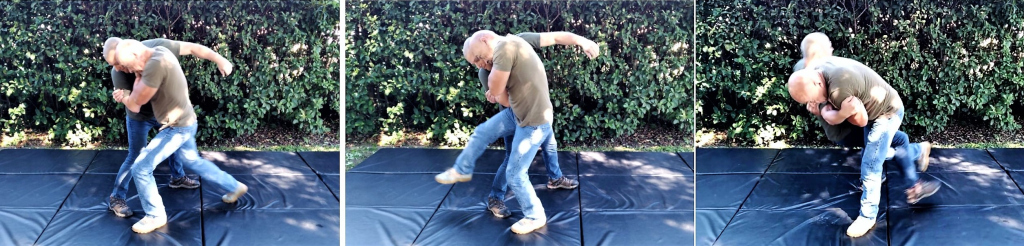
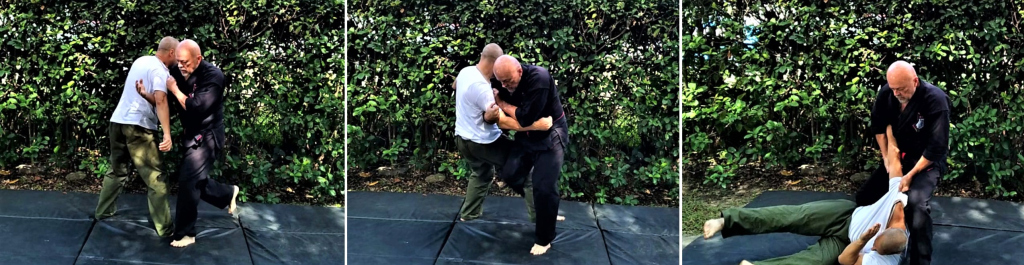
4.) After crashing into the attacker forcing him backwards the defender’s then grabs the attacker by the shirt with his left hand at the top of the attacker’s right shoulder. As he steps toward eleven o’clock, the defender drives his shoulder and head into the attacker. His right-hand shoots under the attacker’s right arm and grabs his arm just above the elbow. 

Note: Pulling the attacker’s right elbow toward his left as you push his head with your head to his right further disrupts his posture and balance. 

5.) The defender pulls the attacker’s right elbow into his right hip and brings his right leg forward and up in between his left leg and the outside of the attacker’s right leg. 

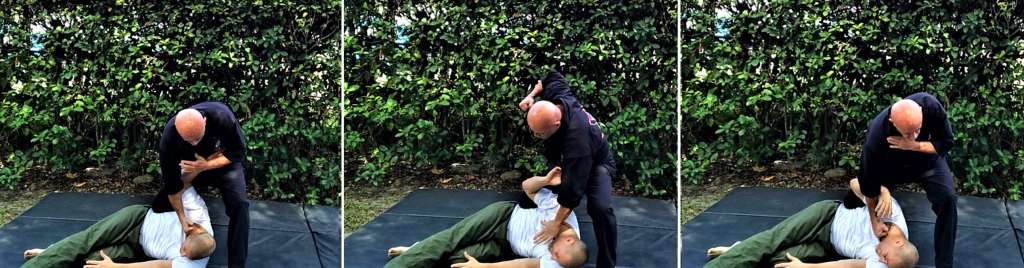
6.) The defender swings his right leg downward and back without letting his right foot touch the ground hitting the back of the opponent’s leg. Sweeping the attacker’s leg high, the defender continues to pull with the left hand and drive his head and shoulder downward. Turning his right shoulder toward the left continue the pull to take the attacker to the ground to finish the throw.

 (To do the technique to the opposite side substitute the word “left” for “right” and “right” for “left”.)

Tuesday, November 5, 2024

Barron Shepherd Judo: Tsuri Komi Goshi - Lifting Pulling Hip Throw

 Tsurikomi Goshi - Lifting and Pulling Hip Throw, is one of the original 40 throws of Judo as developed by Jigoro Kano. It belongs to the second group, Dai Nikyo, of the traditional throwing list, Gokyo, of Kodokan Judo. It is also part of the current 67 Throws of Kodokan Judo. Tsurikomi Goshi is classified as a hip throwing technique (Koshi-Waza).

Tsuri Komi Goshi - Arm Pit grip Variation

1.) Both players are fighting in a right vs right situation.  

2.) Blue punches a right armpit grip.   

3.) The opponent immediate grips Blue right sleeve reaches for a high collar or back grip with his left. As the opponent starts to reach for the high grip blue pulls with his left hand and brings his right arm under the opponents arm pit as he steps to the inside with his right foot to the inside of the opponent's right foot. The opponent misses his left high grip as blue is moving under it and to the inside. 

4.) Blue starts to pivot on his right foot as his left hand comes up under the opponent's armpit. 

5.) As Blue continues his pull with the left hand he pivots 180 degrees he bring his left foot in line with his right foot. 

6.) Blue straightens his legs popping his hips upward and pulls his left elbow to his left hip turning his upper body counter clockwise to finish the throw.

Sunday, November 3, 2024

One Handed Seoi Nage Split Entry Drop Knee

 Without a doubt The CRAZIEST throw in JUDO history is the one handed Seoi nage. The Great Toshiko Koga is renowned for this technique. He hit a standing variation in the 1989 world championships. Since then, the Koreans have some drop knee variations of it as well. 

Designed to catch your opponent off guard, this one handed variation of seoi nage utilizes the split step entry and dropping to the right knee. 

1.) Blue and white are standing with the right foot forward.

2.) White reaches with his right hand attempting to get his grip. Blue parries the grip attempt

3.) Blue immediately punches in a grip with his right hand at white's right lapel. 

4.) Blue's left foot drags up to the back of his right foot as the right foot starts to move forward.

5.) As Blue pivots his right elbow comes up under white's left armpit.  As the right foot enters between white's feet drop to the right knee. (The placement of the knee should be past the toes of the opponent's lead foot.) Blue pulls with his right hand turning his body counter clockwise.  Blue's places his left hand on whites left hand keeping control of it to keep white from cartwheeling out of the throw,

6.) Then the left foot slides back past the right knee for maximum leverage. Bring the right elbow to the left hip turning counter clockwise to finish the throw.

Saturday, November 2, 2024

Barron Shepherd Judo - One Handed Technique Series

My specialization and my obsession (LOL) with the one handed style of judo began when I first saw Toshihiko Koga hit a one handed seoi nage in the 89 world judo championships. His dynamic one handed standing seoi-nage captured my imagination. I remember immediately doing my best to replicate it in class after class. Since then it's been a almost 40 journey, a lifestyle dedicated to specializing in that particular method adding more and more to it and to this day continuing to build on it and will probably do so until I die.

There have been few who have used this method. And by few I mean about 4. Not many at all. The master of the one handed Seoi nage was Toshihiko Koga. There are only very few one handed throwers Udo Quelmaz and most recently Soichi Hashimoto and Hifumi Abe (both have a one handed sode tsuri komi goshi). There are indeed a plethora of throws to be executed from a one handed grip. 

Barron Shepherd Judo 

There are three things I say all the time;  

1.) First grip. First attack. Finish and try to look dope while you're doing it.  

2.) Grip fight like a boxer and have footwork like Barry Sanders.  

3.) Anytime judo is used transcend rule, transcend theory and become a demon. 

The one handed style is a dynamic, ballistic and athletic method that is better utilized from a more upright stance, like that of a boxer. Everything about this fighting method of Judo from the stance (false lead) onward is unorthodox and has a distinct purpose. The one handed style catches the opponent off guard. The split stance or split step entry gets the hips under the opponent’s and makes it easy to load him up. Once the opponent is loaded up there’s little he can do to avoid getting thrown.

One handed Ippon Seoi Nage Drill - Split Step Entry

1.) Stand with the right foot forward 2.) Punch in your grip with the left hand.  3.) Pull with your left and and bring your left foot up to your right foot.  

4.) as the left foot comes up toward the top of the triangle pivot slightly toward 6 o'clock as your right foot moves past the base line of the triangle next to the opponent's right foot.  5.) The left foot slides back toward the baseline of the triangle next to the opponent's left foot.  Straighten the legs and pop your hips upward.  6.) Turn your body counter clockwise taking your right elbow to your left hip to finish the throw.

Entering into the Throw with the Rear Foot

In one of his Seoi nage variations Toshihiko Koga would enter into a seoi nage with the rear foot. In this variation of the one handed drill, I am entering into ippon seoi nage with the rear foot using a back step. My rear foot steps behind my lead foot past the base line and to the corner of the triangle. 


Koga variation in competition...........

The following throw is the koga variation that he used used in competition. The rear/right foot steps to the bottom corner of the triangle just inside the opponent's right foot.

The Importance of Taping a Triangle on the Mat.................

If you notice in the pictures I have a triangle taped on the mat with a single straight line taped a foot past the base line of the triangle. Stepping to certain points of the triangle ensures maximum leverage creating a more effortless throw. 

NEXT UP ON TAP: Tsuri Komi Goshi 


Eddie Sebastia, IBJJF Competitor, 62-2 In competition. Purple Belt World Champion, Brown Belt World Champion, Black Belt Pan American Champion, 2023 IBJJF No-Gi World Champion

I have been doing some form of grappling for over 40 years. I started wrestling as a young teenager. I went on to Judo in my later years. After years in this sport, I pursued BJJ. I have achieved the level of a 2-stripe Black Belt. BJJ is where I became a 2 
times Masters IBJJF World Champion and 2 times Pan Am Champion and 2023 Masters IBJJF  No-Gi World Champion.

I met Barron after a BJJ tournament in 2022, he was teaching Judo at one of our Carlson Gracie schools. I have been working one on one with Barron, both of us trading knowledge of the different aspects of our particular styles, BJJ and Judo. 

When it comes to judo, I appreciate Barron’s style of teaching, not only with the specific drills that he utilizes to supplement and reinforce his judo techniques, but his overall approach of how to properly execute the techniques. 

One of the things that I especially like about Barron’s style of Judo is his approach to grip fighting and his one-handed style gripping attack. I have implemented this into my game. It has not only helped me with my stand up, but also with my ground game.

Dr. Rich Meagher

I have been doing martial arts for nearly 30 years, and I've never met anyone that can throw like Coach Barron Shepherd. Unlike traditional Judo stylists, Barron doesn't concern himself with complex grips or ideal timing. His focus is on getting the grip that matters and then delivering a ballistic throw. Coach Barron's explosive, dynamic style catches everyone off-guard, no matter if it's a sport or street context. His functional footwork is the Hallmark of his explosive throws. 

Coach Barron is the sole reason I am able to execute Judo throws in a modern, combative situation. The Combat Judo curriculum is an excellent way to introduce students to throws and how to hit them in real altercations. Anyone who can develop at least half of Coach Barron's ballistic, threatening style of Judo, is a force to be reckoned with.


Lauren Meece, 2000 Olympian, Coach, Scouter and Trainer US National Champion Pan Am Games Bronze Medalist 9th place finish – World Championships

Carlson Gracie Winter Haven’s openness to judo is primarily due to Barron Shepherd’s passion to ensure judo is adapted and utilized for their BJJ students. I have traveled all over Central Florida, and while most BJJ and MMA locations seem to discredit judo, (and the overall effectiveness of adapting judo gripping strategies), Barron and his team at Carlson Gracie are the minority that truly understand the value of what judo can bring. 

There are many common misconceptions about the effectiveness of judo, however, it is eye opening to see individuals like Barron and his Carlson Gracie Team continue the legacy of judo and display its relevancy in the world of martial arts. 

Thank you to Barron and Carlson Gracie Winter Haven for ensuring that judo lives on and adapts for the BJJ community to access as well. As judo and BJJ evolves, I see minorities like this becoming pioneers not only in BJJ and judo, but in the overall spectrum of mixed martial arts. 


Andrew Kinchen, owner/Head Instructor Carlson Gracie Winter Haven. Instructor Carlson Gracie South Lakeland. Instructor Carlson Gracie Lakeland

Andrew Kinchen and Carlson Gracie Jr. 
Judo has many styles and variations in its application but none are as progressive as Barron Shepherd Judo. 

I first came across Coach Barron Shepherd around 2016. A training partner of mine, Brian Bradway was attending Barron’s Friday Night open mat sessions at the City of Winter Havens chain of lakes complex. At that time, I was a Purple Belt in Brazilian Jiu Jitsu and just looking to add some tools into my game. I was immediately taken by Barron’s willingness to cater his curriculum to what we were looking for. He narrowed down a combination of throws that would work well in the BJJ arena. I would go on to drop in on his Friday Night classes to continue learning Judo from him. As the years went on and Covid came into our world, the Judo program was shut down by the city. 

After becoming a black belt in BJJ under Rafa Santos I again sought out to continue my learning. I reached out to Barron to bring his style of judo within the walls of Carlson Gracie Winter Haven. The biggest take was Barron’s high-level attack-oriented game.

I’ve proudly trained under Barron for the better part of 7 years. Learning to aggressively grip, the dynamic entries and his unique one handed style of Judo has added many new options and facets to my game. Being able to play very quick allowed the BJJ players in our gym to continue our attacking style openings to dictate the pace and position of fights. I’ve been able to add to my personal game; I actively compete and the confidence has helped tremendously. I’ve implemented several throws and variations into my existing game helping give me an advantage on the competition scene. As we evolved with Barron and implemented a one-handed style gripping and attacking many of our guys have evolved into having a well-rounded stand up arsenal to complement our ground game.


Edward Coleman, Brown Belt - Judo 

Sensei Barron’s Judo program is the most dynamic and explosive Judo training I have experienced. His boxing style approach to grip fighting and progressive gripping strategies to Judo, gives a very powerful advantage for grapplers of any system.

In just a short time of training with Sensei Barron, my outlook on grappling strategies and throwing mechanics have changed significantly and has increased my effectiveness in Judo. Sensei Barron’s ease in teaching and personable approach to his students, makes learning from him very engaging and enjoyable.


Derek Walker Brown belt Carlson Gracie Jiujitsu, Coach and Competitor

An explosive showing of precision and power, Barron Shepherd's style of Judo is dynamic and is always moving forward. My name is Derek Walker, I am a Brazilian Jiu-Jitsu Practitioner for thirteen years. 

I met Coach Barron more than a year ago when he joined our Jiu-Jitsu team. Spending time with Barron it is immediately clear he is an experienced Judoka. He is scrupulous in his technique and is dedicated to preserve the dignity and spirit of Judo, something he has dedicated his life to.

Even after the very first lesson Coach Barron taught us, it became clear that his teachings were not classical but very evolved to deal with real life issues. With the popularity of Jiu-Jitsu along with all combat sports, people have become more knowledgeable. Everybody knows throws exist and certainly do not want to walk into them willingly, enter the one-handed style. When Coach Barron grabs your kimono it is with the speed, precision and force. What sets Coach Barron apart from other Judo players I have trained with is when he achieves his first grip the throw immediately begins.

Before Barron trained with us, a single grip on my kimono was bad, but not catastrophic. I did not feel threatened until my opponent achieved BOTH grips. Then like most people, I become hyper defensive, like I can imagine myself being thrown through the air at any second. Coach Barron’s ability to punch in his grip, achieve an off balance and quickly begin his attacks is something practical. It has become an amazing opener in my game. If your opponent is standing in-front of you Coach Barron brings multiple tools to get the job done. A constant onslaught of technique, changing direction one after another will ensure a fundamentally solid stand up game, almost all including just one hand. 

I will say even in a short time practicing these techniques, I have added multiple layers to my game and made them my own. To the gripping style to techniques from classic trips to modern throws. There is something for everyone to add to their arsenal.

Tuesday, January 16, 2024

BARRON SHEPHERD JUDO - KOSHI WAZA: O-Goshi, Koshi Guruma and Uki Goshi

Koshi-waza (Hip techniques) consist of throwing an opponent in a sudden motion, using one's hip as the fulcrum. After pulling an opponent onto one's hip, the Koshi-waza (Hip techniques) may be performed with a leg sweep tecnique, by a shoulder throw technique performed while grasping and lifting one of the opponent's sleeves, or by using the spring force in one's legs to flip the opponent up and over one's hip. Kodokan Judo specifies 11 Koshi-waza (Hip techniques), which include O-goshi, Koshi Guruma, Uki Goshi, Sode-tsurikomi-goshi, Harai-goshi, Hane-goshi, and Uchimata.

Ogoshi (Hip Throw) Split step entry


Ogoshi is often translated as full hip throw. It is classified as a hip technique. When you execute O goshi, you have to turn a full 180° so that your back and hips are flush against the opponent.  You bend the knees as you enter to lower your level then lift your opponent and load them on your back.

1.) Blue is standing in a right foot forward lead. Blue’s knees are bent and his center of gravity low. Twist the upper body clockwise bring the left hand and shoulder to the front closer to the opponent. In a right vs. right situation your right shoulder should be more toward your rear and not out front and easily accessible for your opponent to grip and attack. 

2.) Blue punches in with the left hand and grips the opponent’s gi right above the armpit. Blue’s right hand is up and defending any attempts by the opponent to get his grip.

3.) Immediately after the getting the grip, Blue pulls the opponent with the left hand rocking him forward up off his heels. Simultaneously, Blue steps his left foot up to his right foot. As Blue steps in with his right foot his knees are bent more and his belt line should be lower than his opponent’s belt line.


4.) Blue reaches his right arm around the opponent’s back grabbing the opponent’s gi at the shoulder blade as he steps his right foot between the opponent’s feet. As the right foot lands the toes of both feet should be pointing in the direction of the throw. Blue continues the pull with the left hand breaking the opponent’s balance to his front (note that blue has his oppponent’s head out past his feet).

5.) Blue steps back with his left foot. As the left foot moves back the opponent’s feet should start to come off the mat. Blue straighten his legs quickly, lifting his opponent as he bends forward popping his hips upward into the opponent.

6.) Blue twists his torso to the left by taking his left elbow toward his left knee or hip to finish the throw.


Koshi-Guruma (Hip Wheel) Split Step Entry

Koshi Guruma is classified as a Koshi Waza or hip technique. Koshi guruma is not only a fundamental but it is also a dynamic judo throw. The legendary Toshihiko Koga, well-known for his standing Ippon-Seoi-Nage (split step varation), would sometimes surprise his opponents with a split step variation of Koshi-Guruma. Koshi-Guruma has since emerged to be quite a popular competition technique. Koshi guruma has a high success rate in judo, it is also very effective in no-gi grappling and MMA.

1.) Blue is standing in a right foot forward lead. Blue’s knees are bent and his center of gravity low. Twist the upper body clockwise bring the left hand and shoulder to the front closer to the opponent. In a right vs. right situation your right shoulder should be more toward your rear and not out front and easily accessible for your opponent to grip and attack. 

2.) Blue punches in with the left hand and grips the opponent’s gi right above the armpit. Blue’s right hand is up and defending any attempts by the opponent to get his grip.

3.) Immediately after the getting the grip, Blue pulls the opponent with the left hand rocking him forward up off his heels. Simultaneously, Blue steps his left foot up to his right foot. As Blue steps in with his right foot his knees are bent more and his belt line should be lower than his opponent’s belt line. 

4.) Blue reaches his right arm around the opponent’s back grabbing the opponent’s gi at the shoulder blade as he steps his right foot between the opponent’s feet. As the right foot lands the toes of both feet should be pointing in the direction of the throw. Blue continues the pull with the left hand breaking the opponent’s balance to his front (note that blue has his opponent’s head out past his feet).

5.) Blue steps back with his left foot. As the left foot moves back the opponent’s feet should start to come off the mat. Blue straighten his legs quickly, lifting his opponent as he bends forward popping his hips upward into the opponent.

6.) Blue twists his torso to the left by taking his left elbow toward his left knee or hip to finish the throw.


Uki-goshi (floating hip throw)

“Uki goshi” is often translated to “half-hip throw”. From a beginner’s perspective, O goshi and Uki goshi are the same throw. They are both classified as hip techniques but there are big differences between these two throws. In Uki goshi only one hip makes contact with the opponent, you don’t make a full 180° turn as you do to execute O goshi, with Uki goshi you pivot less. When entering into Uki goshi with the right side, your right hip should make and keep contact to the front side of your opponent’s left hip or belly. High-level judokas execute Uki goshi with only a 90°-100° turn.

1.) Blue is standing in a right foot forward lead. Blue’s knees are bent and his center of gravity low. Twist the upper body clockwise bring the left hand and shoulder to the front closer to the opponent. In a right vs. right situation your right shoulder should be more toward your rear and not out front and easily accessible for your opponent to grip and attack. 

2.) Blue punches in with the left hand and grips the opponent’s gi right above the armpit. Blue’s right hand is up and defending any attempts by the opponent to get his grip.

3.) Immediately after the getting the grip, Blue pulls the opponent with the left hand rocking him forward up off his heels. Simultaneously, Blue steps his right foot slightly toward his opponent’s right foot. Blue’s knees are bent more and his belt line should be lower than his opponent’s belt line.  

4.) Blue pivots his right foot counter clockwise pointing the toes of his right foot toward nine o’clock. Blue pulls with his left hand and reaches his right hand around the opponent’s back grabbing the opponent’s gi just below his left shoulder blade. Simultaneously Blue executes a back step by stepping behind his right foot with the left foot to the inside of the opponent’s left foot.

5.) Blue then immediately steps his right foot back next to his left foot. As the right foot moves back the legs straighten and the opponent’s feet come off the mat.

6.) To finish the throw, Blue pulls his left elbow across his body and to his left hip, twisting his upper body to the left and taking the opponent to the mat.

Thursday, December 28, 2023

Barron Shepherd Judo: Progressive Grip Fighting


A lot of people who start judo want to start off in judo learning it's big and fancy looking throws. Trying to throw an experienced grappler or judoka is extremely difficult without knowing how to fight to get your grip. Grip fighting is an art in itself and most importantly a fundamental part of judo that is worth learning. It requires serious time in training and if you don’t put the time into this, you won’t progress very far with your throws.

Grip fighting is ultimately the act of grabbing your opponent's gi where YOU desire without letting the opponent get the grip(s) he wants in such a way that prevents you from attacking. The more effective your grip fighting the more you create opportunities to set up AND enter into your throws. 

Have a grip fighting strategy

Be aggressive in getting your grip. Always try to get your hands on your opponent first and get the dominant grip. Don’t fight on his terms and don’t let him have the better grip or tie up. Be specific with getting your grip it should lead to something. Your throw flows naturally from your grip. Make sure the grip you use works best for the throw you want to use.

Grip fighting means just that "grip fighting!" Don’t change your stance stand your ground and fight for the grip you want. Be fast - Be ballistic - Be explosive. Think boxing - punch in your grips like a boxer, you can use combinations, you can feint and you can even parry you opponent's grip attempts in the same manner a boxer parries punches.

If you can’t get the dominant grip, try to break his grip and counter with your own grip

Get the first grip

A judo throw requires the establishment of a strong grip. An offensive gripping strategy can help keep the opponent or adversary on their heels both literally and figuratively. Not having a solid plan for your grips can leave you vulnerable and at the mercy of your opponent.

Arm pit grip (waki)

Outside of Japan the arm pit grip is a pretty rare gripping method. Some of the great Japanese judo players have used this grip successfully in their offensive arsenal. Gripping the folds of the cloth at the area of arm pit is extremely versatile. It provides incredible defense and distance control.

Blue inserts the fingers of his left hand into the fold of the gi just above the opponent’s arm pit. Grip the gi with primarily the bottom three fingers of your left hand and drive the pinky finger into the opponents chest and turn the hand over slightly clockwise palm down.

The arm pit grip is very useful in blocking an opponent’s attacks, restricting his movements and keeping him at a safe distance. It is extremely effective in a right vs right situation or an opposite stance, right vs. left situation (Kenka Yotsu). It helps control his arm making it harder for him to put his hand down to block a throw, it also keeps him from reaching over the top of your shoulder. In the one-handed judo style you have the added benefit of the opponent not feeling threatened by only a single grip. Unlike a pull on the sleeve or the lapel pulling at the armpit is a much shorter pull.

Right vs Right – Punching in your grip

A right vs right situation refers to both players being right-handed meaning the majority of their throws will be to the right side. In a right vs. right situation (pictured) your right shoulder should be more toward your rear. The right hand is held further back and away from your opponent and not out front and easily accessible for your opponent to grip and attack.  Your left hand or the gripping hand is active and offensive. Your right hand or rear hand is ready and active as well to defend against your opponent’s gripping attacks and can be used for feints to set up your throw.

1.) Stand with the right foot forward. The knees should be bent and center of gravity low. Feet are shoulder width apart. Twist your upper body clockwise bringing your left hand and shoulder to the front closer to your opponent. Your left hand is primarily your attacking hand and should be positioned closer to your opponent. The right hand acts primarily as the defensive hand.

2.) Much like delivering a jab in boxing, punch in with your left hand and grip your opponent’s gi right above the armpit. Your right hand is up and defending any attempts by the opponent to get his grip.

Grip fighting is Boxing!!!

Grip fighting in judo is a fairly recent development. There is great value in getting and preventing grips. Grip fighting, used aggressively, creates multiple opportunities to set up your throws and takedowns. Some Modern Olympic elite level judo competitors look like boxers, circling each other while jabbing and probing their opponent's defenses, countering the opponent's grip attempts and punching their hands in for a perfect grip. 

Grip fighting represents the very highest levels of competition however, at the lower levels of competition judo and in judo clubs around the world grip fighting isn't  really seen or even practiced. The approach of a no grip fighting style of judo is still very, very much predominant. 

Dont let the opponent get his grip

Another important detail in grip fighting is don’t be so focused on getting your grip that you allow the opponent to get their grips. 

Parrying the opponent’s grip attempt and counter gripping

As stated earlier in a right on right situation your attacking hand is primarily your left hand and the right hand is primarily your defensive hand. Look to counter your opponent’s grip attempts with the right or rear hand.

Outside Parry

1.) Blue is standing in a right foot forward. Both of his arms are bent and both hands are held at chest level. The left hand is held slightly in front of his right hand positioned closer to white.  White is standing right foot forward lead.

2.) White attempts to get a lapel or collar grip with his right hand. Blue turns his upper body slightly to his left as he parries white’s attacking hand to the outside with his right hand as he shuffles forward slightly.

3.) As if throwing a lead straight punch or a jab in boxing blue shuffles forward and punches his in grip, rocking white backwards and gripping him at the front of white’s gi just above the arm pit.

Inside Parry

1.) Blue is standing in a right foot forward. Both of his arms are bent and both hands are held at chest level. The left hand is held slightly in front of his right hand positioned closer to white.  White is standing right foot forward lead.

2.) White attempts to get a lapel or collar grip with his left hand. Blue turns his upper body slightly to his left as he parries white’s attacking hand to the inside with his right hand as he shuffles forward slightly.

3.) As if throwing a lead straight punch or a jab in boxing blue shuffles forward and punches his in grip, rocking white backwards and gripping him at the front of white’s gi just above the arm pit.

Double Parry

1.) Blue is standing in a right foot forward. Both of his arms are bent and both hands are held at chest level. The left hand is held slightly in front of his right hand positioned closer to white.  White is standing right foot forward lead.

2.) White attempts to get a lapel or collar grip with his left hand. Blue turns his upper body slightly to his left as he parries white’s attacking hand to the inside with his right hand as he shuffles forward slightly.

3.) White attempts to get a lapel or collar grip with his right hand. Blue turns his upper body slightly to his left as he parries white’s attacking hand to the outside with his right hand as he shuffles forward slightly. After the parry punch in counter grip as shown in inside and outside parries. 


Lead Hand Inside Parry to Lead Hand Counter Grip

Though the left or lead hand is primarily the attacking hand and the right or rear hand is primarily used defensively that doesn’t mean their roles cant be switched.

1.) Blue is standing in a right foot forward. Both of his arms are bent and both hands are held at chest level. The left hand is held slightly in front of his right hand positioned closer to white.  White is standing right foot forward lead.

2.) White attempts to get a lapel or collar grip with his right hand. Blue turns his upper body slightly to his right as he parries white’s attacking hand to the inside with his left hand.

3.) As if throwing a lead straight punch or a jab in boxing blue shuffles forward and punches his left hand in to grip, rocking white backwards and gripping him at the front of white’s gi just above the arm pit.

Lead Hand Inside Parry to Rear Hand Counter Grip

1.) Blue is standing in a right foot forward. Both of his arms are bent and both hands are held at chest level. The left hand is held slightly in front of his right hand positioned closer to white.  White is standing right foot forward lead.

2.) White attempts to get a lapel or collar grip with his right hand. Blue turns his upper body slightly to his right as he parries white’s attacking hand to the inside with his left hand.

3.) As if throwing a lead straight punch or a jab in boxing blue shuffles forward and punches his left hand in to grip, rocking white backwards and gripping him at the front of white’s gi just above the arm pit.


Monday, December 18, 2023

BARRON SHEPHERD - SIXKILLER KAJUKENBO KSDI

The strength of Kajukenbo lies in how techniques from the different styles that made up Kajukenbo (Karate, Judo, Kenpo and Boxing) are combined. Taking the opponent out of the fight as quickly as possible by delivering techniques in combination, as BALLISTIC as possible, to cause as much damage possible, is the aim of Kajukenbo. The most effective of its techniques are ones that effectively dole out the principles of physics quickly and forcefully, coupled with a will to achieve the goal.

Punch Counter Against Double Jab

1.) Both Fighters are fighting out of right foot forward lead.  2.) The opponent throws a straight right lead punch (jab). Parry the punch with your right lead hand.  3.) The opponent doubles up on his jab and immediately throws another. Lean back slightly pivoting counter clockwise toward nine o'clock and rolling your right shoulder up to protect your chin. Your left stays up next to the left side of your chin and jaw. 


 4.) Immediately counter the opponent's second jab with a left cock screw punch as you pivot both feet clockwise to twelve o'clock. Your left foot raises off the heel as you deliver the punch. Your right hand chambers at the right side of your chin  5.) Pivot on the lead foot as you step your rear foot toward nine o'clock and execute a right upper cut to the chin of the opponent.  6.) Shuffle forward slightly by pushing off the left foot and stepping forward with the right foot. Strike your opponent’s right shoulder with a straight left heel of palm strike and grab his clothing at the area struck. This strike should be hard enough to disrupt his posture and rock him back on his heels.  

7.) With a short quick jerk with the left hand, pull the opponent into you. This should rock him to his front and off of his heels. As you pull step your left foot toward your right foot, your knees should be bent and your belt line should be lower than his belt line.  8.) Bring your right hand up under the opponent’s right armpit. Your right foot steps forward between the opponent’s feet pivot counter clockwise on your left foot and continue to pull with the left hand. As the right foot lands between deep between the opponent’s feet the toes of both feet should be pointing straight in the direction of the throw. Pinch the opponent’s right arm at his arm pit between your right forearm and bicep. Rotate the palm of the right hand toward your head (this creates a tighter clamp on the opponent’s arm).   9.)  Step back with your left foot next to the opponent’s left foot (as you step back with the left foot between your opponent’s feet they should start to raise up off the mat).

10.) Straighten your legs quickly and pop your hips upward into the opponent.  11.) Continue to pull and twist your torso to the left, taking your right elbow toward your left knee and drive the opponent to the ground.   

Immediately after the throw you can follow up with ground and pound see steps 13,14 and 15 in previous article.       

DYNAMIC KAJUKENBO BY BARRON SHEPHERD COMING IN 2024


COMING FEB/MARCH 2024

 FOREWORD

 TRAVELLING THE PATH

 Colonel G.H. Bristol USMC (retired) Creator and  Developer of the MCMAP , the U.S. Marine Corps Martial Art Program.

 Martial artist travel along a path. Some find the beginning of that path in a dojo and remain for a lifetime. Others have a shorter experience and move on to other endeavors. Some remain with one discipline for their entire length of the path. Others travel multiple paths and experiment with that of weapons, grappling, striking, and other aspects of the combative spectrum.

But a few exponents choose a different walk. They absorb multiple aspects of well-established disciplines and patiently – yet relentlessly – fuse them into their own unique personal fighting philosophy. Barron Shepherd is one of those martial artists. A lifetime journey of dedicated training, learning, absorbing, fusing, and teaching – and training again.

A man of considerable physical capability and capacity, a keen eye for technique, and a humble yet disciplined pursuit, he has walked a long winding road in JUDO and KAJUKENBO – first as a student and now as a teacher and advocate for both. Those who know him agree that he seeks to find the best within the training continuum and then pass it along to others for their benefit.

Talking with him regarding his latest book "Dynamic Kajukenbo", he is – as always – passionate, well-informed, and trains himself and others in what has become a lifetime of learning and DOING. As you read and see the in-depth technical and explosive application of a martial discipline that is at its core a FIGHTING art, you will better know the author.

I know him, so I will give you a thought as you begin to read. The author is a man who can execute – at a high and lethal level – every technique and application he describes. He is a lifelong learner and exponent. But more importantly, he is a man who – to those he knows and trains – would answer the call to those oppressed of the beginner who desires to learn. That combination is at the heart of a fighting man with a pure love of what he does.

Get to know Barron Shepherd in this book. I believe that you will find it informative, motivating, and strikes at the heart of what martial arts is all about. - SEMPER FIDELIS! GH Bristol


             ----------------------------------------------------------------------------------------------------

The original concept of Kajukenbo was to build a fighting system that worked in the street. Kajukenbo was NOT the peaceful way, nor was it the way of de-escalation.  Kajukenbo’s mindset was and is one of approaching or attacking violence with greater overwhelming violence. Hit first, hit fast, hit hard and finish the guy! Kajukenbo was never about avoidance. Engagement and destruction were the strategy and tactics of Kajukenbo.

1.) Both you and the attacker are in a right foot forward fighting stance. Your knees bent and your rear foot is slightly raised off the ground.  2.) The attacker shuffles forward and executes a lead round house punch. Pivot on the right foot counter clockwise toward nine o’clock and strike the attacker’s right arm with the boney area of both of your forearms.  3.) From the point of contact, bend the knees and drop into right hammer fist and left forearm strike knocking the attacker’s arm downward. 
4.) Immediately turn clockwise toward twelve o’clock and execute a right hammer fist to the attacker’s jaw or neck. Your left hand chambers at your right shoulder  5.) Pivot on the rear foot clockwise toward ten o’clock and deliver a straight left punch to the attacker’s jaw. You right hand chambers at the right side of the head.   6.) Pivot counter clockwise toward nine o’clock and strike the left side of the attacker’s jaw with an left outward hand sword turning his head to this right. 
7.) Dropping the hips, deliver a right hammer fist to the left side of the attacker’s jaw. The right left hand rechambers at your right shoulder.  8.) Pivot clockwise toward twelve o’clock and strike the front of the attacker’s right shoulder with a hard left open hand check and grab his shirt at the area struck.  9.) Pull with the attacker toward you as you shift your right foot back slightly and push off it to move toward eleven o’clock.
10.) When you drive of the left foot step your right foot to eleven o’clock and to the outside of the attacker’s right foot  11.) Pulling with your left hand bring your right knee forward and up in between your left leg and the outside of your opponent’s right leg. Swing your right leg downward and back without letting your right foot touch the ground. The back of your calf should make contact with the back of your opponent’s calf. Continue your pull with your left hand bringing your left elbow to your left hip.  Continue with the sweep taking your opponent’s leg upward. Sweep his leg high. While sweeping your opponent’s leg drive his shoulder downward to the ground by continuing to pull your left elbow to your left hip.   12.)  The attacker lands on his left side and is turned away from you. Keeping control of his right arm, immediately place your right knee and shin against the attacker’s ribs and back. 
13.) Drop your hips pivoting counter clockwise on the ball of your right foot and deliver a right straight punch downward to the side of the attacker’s head. Your left hand chambers at your right shoulder.  14.) Twisting your hips back clockwise immediately follow up with a open hand check or a left outward edge of hand strike to the attackers jaw or side of head.  As your left hand checks or strikes your right hand chambers.  15.) Pivot again counter clockwise on the ball of your right foot and drop your hips downward as you deliver a straight punch to the attackers jaw, rechambering your left hand at your right shoulder.


Tuesday, December 5, 2023

DYNAMIC KAJUKENBO BY BARRON SHEPHERD

AVAILABLE 2024

If Boxing is called the sweet science then Kajukenbo should definitely be referred to as the savage science of street fighting.  Kajukenbo was developed as a brutally effective street fighting system, the reader should take notice that I didn’t say self-defense system. 

The creators of Kajukenbo literally brought the street into the dojo. Those who brought about the concepts and creation of Kajukenbo trained like they were fighting in the streets and knew if they didn’t get it right, they would likely end up cut, beaten, stabbed, shot and even dead.

Kajukenbo is NOT the peaceful way! It is NOT the way of de-escalation! Kajukenbo’s mindset is one of approaching or attacking violence with greater overwhelming violence. Hit first, hit fast, hit hard and finish the guy! Kajukenbo’s history shows us that Kajukenbo was never about the avoidance of violence. Engagement and destruction were the strategy and tactics of Kajukenbo.

The strength of Kajukenbo lies in how techniques from the different styles that made up Kajukenbo (Karate, Judo, Kenpo and Boxing) are combined. Taking the opponent out of the fight as quickly as possible by delivering techniques in combination as BALLISTIC as possible to cause as much damage possible is the aim of Kajukenbo. You cannot do these things if you don’t ground yourself in the principles of physics. The only way for optimal performance in Kajukenbo is to understand the forces at work, by the numbers, then work on increasing the value of those numbers though repetition.

Kajukenbo is literally opening the whole can of “whup ass”. The most effective of Kajukenbo techniques are ones that effectively dole out the principles of physics, quickly and forcefully coupled with a will to achieve the goal. Physics in Kajukenbo might not seem like the most obvious subject to consider, but for a science that seeks to understand everything about the elements of motion, energy and force, the connection to Kajukenbo is clear. The six principles of physics that are important in Kajukenbo are acceleration, force, momentum, energy, speed and velocity. Their  interdependence is a key factor in Kajukenbo's combination attacks.  

Kajukenbo is a fighting style geared for the streets. The test of truth regarding your fighting skills is whether they work or not. The basics of applying any successful technique be it a punch, a kick or a throw can be broken down into a few factors:

Acceleration – Without acceleration there is little or no power. Acceleration determines whether your technique hits or misses or if you can be countered or not. If honed by practice for control acceleration can become an over whelming factor in a street fight.  

Force – Force is a factor that results in the acceleration of an object. You will want to make sure that over time you develop a sense of how much force is being generated by your acceleration, so you can improve your acceleration.

Momentum – Momentum is defined as the product of an objects mass multiplied by its velocity. An effective technique is usually going to be very quick and strong. The goal is to generate maximum velocity allowable by time and space.

Energy – Energy plays an important role in the physics of Kajukenbo, the more energy your tecniques and combinations possess the more damage you can do.

Velocity – Velocity is a term often used interchangeably with Speed, however, their physical definitions are quite different. Speed is a quantity that only has magnitude not direction. It refers to how fast an object is moving. Velocity is a vector quantity and it refers to the rate at which an object changes its direction. The difference being that is Velocity has direction and magnitude. If one wants to punch harder or develop a bone breaking throw training may need to focus in the torsional vector. Meaning improving the velocity of rotation where these forces are often applied in punching striking kicking and throwing. 

Physics as well as the kind of physical and mental toughness built through hard training is the way to win street altercations. A study of physics in relation to such a diverse fighting method like Kajukenbo can help us better understand how to use our bodies more efficiently to deliver ballistic movements and techniques. Breaking down the way energy is harnessed into our mass and our speed, physics gives us a clear view of where we can improve. It provides a road map to how we can become better punchers, kickers, throwers etc. Improve in all areas and ranges of motion, so we can hit harder and faster. It will give one the competitive edge and the advantage in the street! The place Kajukenbo was designed in mind for.

As an older Kajukenbo practitioner and athlete (yes, serious KJKB practitioners are in my opinion combat athletes), while being tough and being in shape are necessities, I have come to understand that knowledge of bio mechanics and understanding the elements of motion save wear and tear on the body. Proper biomechanical execution and knowledge of what makes our techniques sound and can function the most efficiently can increase your longevity. Giving us the ability to keep training strong so that we can remain strong!

Lastly, Kajukenbo is a brutally extreme fighting method which more than potentially revolves around a life or death scenario….not a ring. One may take punishment but one also has to be tough enough withstand and then dole it out. There are no rounds in the street, no time outs, no rest periods.  Your own style of fighting is a personal thing. This only develops through diligent training. Only then will the moves which you will depend on become automatic, reflexive and instinctive. The best style then is a versatile collection of moves, striking, punching, kicking, throws and takedowns that works well for you that are and can be performed at the level of optimal performance.

Limb destruction, Trap, Elbow strike to Split Entry Shoulder Throw

1.) The attacker is standing in a left foot forward lead and the defender is standing in a right foot forward lead.  2.) The attacker moves forward and throws a right rear hand straight punch. The defender parries the punch to the inside and toward the right as he pushes of the back foot and shuffles slightly toward 11 o’clock to the outside of the attacker’s punch.  3.) The defender simultaneously brings his right arm up and parries the punch with the outside of his forearm. His left is up at the chin and the right side of his head is covered with his bicep and forearm.

4.) The defender immediately pivots toward one o’clock. Bending his knees and dropping his center of gravity he grabs the opponent’s right wrist with his right hand and strikes the back of the opponent’s right arm just above the elbow with a left upward elbow. (Steps 3 and 4 shown opposite angle on next page).  5.) The defender checks/traps the opponent’s right arm with his left hand.  6.) Pivot on the back foot counter clockwise and drop step toward eleven o’clock with the right foot and deliver a roundhouse elbow. The elbow strikes the front of the opponent’s right shoulder at the area just above the armpit and turns the opponent’s upper body back toward the defender.   

Steps 3.) and 4.) shown from opposite angle

3.) The defender simultaneously brings his right arm up and parries the punch with the outside of his forearm. His left is up at the chin and the right side of his head is covered with his bicep and forearm.  4.) The defender immediately pivots toward one o’clock. Bending his knees and dropping his center of gravity he grabs the opponent’s right wrist with his right hand and strikes the back of the opponent’s right arm just above the elbow with a left upward elbow. 


7.) Keeping your knees bent drop your center of gravity and immediately strike your opponent’s right shoulder with a left heel of palm strike and grab his clothing at the area struck. This strike should be hard enough to disrupt his posture and rock him back on his heels. 8.) With a short quick jerk with the left hand, pull the opponent into you. Simultaneously begin to pivot counter clockwise into a split entry throw on the left foot. As you begin the pivot bring your right knee up toward your chest. 9.) The right hand moves up under the opponent’s right armpit. The right foot drops back between the opponent’s feet and to the inside of his right foot. The toes of both feet should be pointing toward seven o’clock.


10.) Pinch the attacker’s right arm at his arm pit between your right forearm and bicep. The defender Steps back with the left foot next to the opponent’s left foot.  11.) Straighten your legs quickly and pop your hips upward into the opponent.  12.) Continue to pull and twist your torso to the left, taking your right elbow toward your left knee to finish the throw.  

Explaining the Split Step Entry (Kodokan Judo)

Footwork entries into judo throws include the Split-Step entry and the Back-Step entry. Both allow you to step deeper in between your opponent’s feet allowing for maximum leverage. The Split entries can be utilized in different scenarios addressing different types of attacks from different angles. It will also allow you to make adjustments during the course of the execution of a throw if your opponent tries to step back or away from a throw either incidentally or purposefully. Of the three entries into throws the step pivot, the split step and the back step. The split step methods are the most effective they allow you to enter at different angles and allow for greater execution of force. 

Split Step Entry Shoulder Throw 


1.) As you step forward with the right foot to the top of the triangle punch in your grip with your left hand.  2.) Grab the gi and pull with your left hand at he same time bring your left foot up next to your right foot.  3.) Step forward between the opponent’s feet with your right foot through the triangle and pivot on the left foot. Your right arm moves under his right arm and pinches his arm between your bicep and forearm at his arm pit. The toes of both feet should be pointing in the direction of the top of the triangle.  4.) The left foot moves in between the opponent’s feet. The toes of your left foot should be in line with the base line of the triangle. As the left foot moves back his feet should lift up off the ground. To finsh the throw twist your upper body bring your right elbow to your left hip.